Change Log for DisARMing Code
I was initially thinking DisARMing Code is just perfect, and - unlike my
other books - will not need further updating. Oh, how wrong of me :-)
First, there were a bunch of embarrassing typos and errata (little/big
endian, sheesh, you'd think after 20+ years in the industry I'd get this
right, even authoring in the wee hours..). Those are all fixed, finally, and I
thank the readers who communicated them to me.
Then there was the suggestion of Simon (s03) to cover XZone. Readers of the
book surely noticed that Darwin's libmalloc got paltry mention, especially
considering the deep detail on Scudo and GlibC. Some of this was due to my
already existing discussion in M-I/9, but a large part due to the biggest
change - The xzone malloc - being deliberately closed source.
Simon got me to look and see that, by now (April 2026), XZM has been open
sourced - probably due to AAPL no longer keeping MTE under wraps. This made me
effectively rewrite that entire section, bringing it on par with Scudo/Glibc
and really making this chapter complete, IMHO.
Continuing in the tradition of MOXiI and Android, when I add
significant content (on order of a page), I'll provide it in full here, so
early readers can get it by reading below. There a couple of other pages
(Linux IO URings and GCD minor additions). This is the best I can do. The book is not a subscription, and
all other publishers leave with you a print book that grows older and
outdated even before it sees first print. I'm trying, at least, to catch up as much as I can, and doing it
with no charge. Oh, and you're welcome.
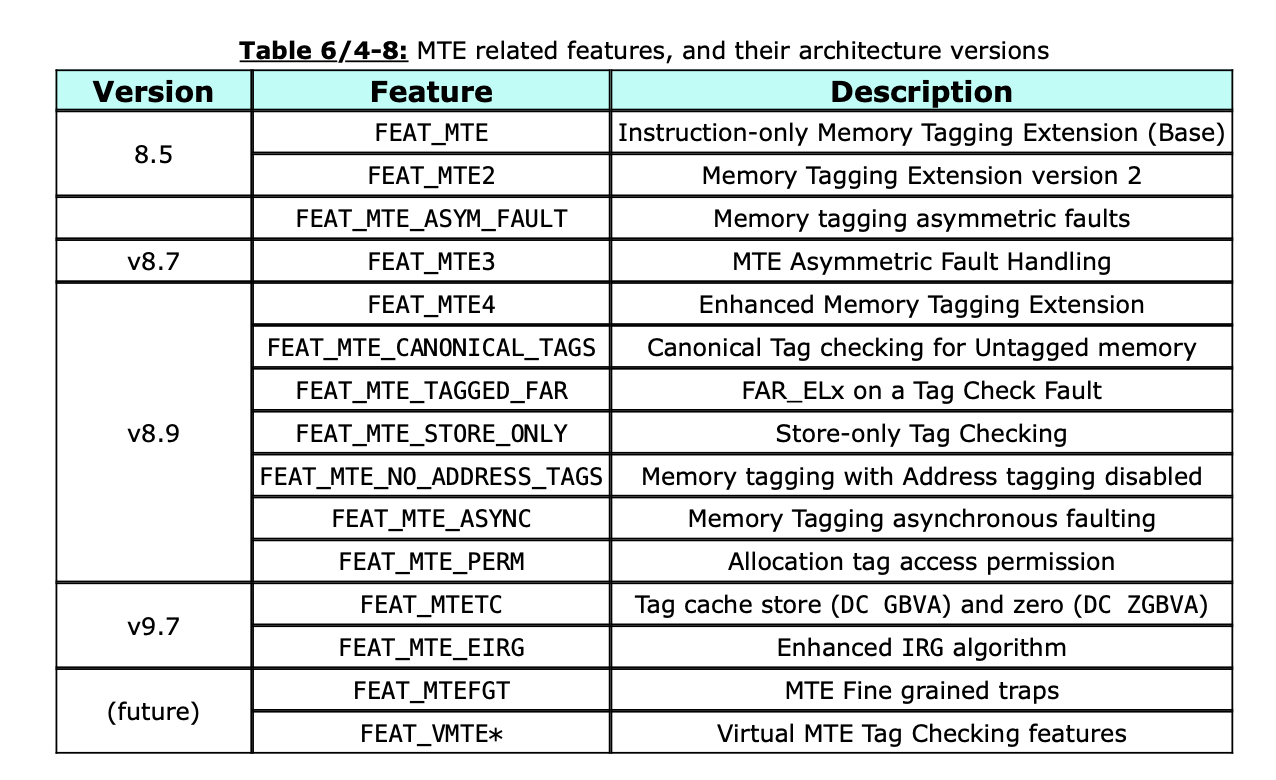
This rather important update brings the book to v1.1. I also catch up
with ARMv9.6 (which is finally public in version M.a of the manual), as well
as 9.7 and even "future technologies", from what
little ARM's website is willing to detail. The full list follows:
- Chapter 1:
- Chapter 2:
- Table 2/2-3: added
randomize_layout
attribute (used in the Linux kernel and pretty useful)
- Chapter 5:
- Added In preface

There is much more to memory than can be discussed here, in particular the physical aspects (SRAM, DRAM, caches), which are left outside of the scope of this chapter. A great reference can be found in LWN.net's 9-part series, "
What every programmer should know about memory".
[lwnm]
- Added 2.2.4 (after Purg(e)able memory), since AAPL introduced a new Mach
trap and are using this in the xzone allocator:
2.2.4 Deferred Reclaim (Darwin 25)
Darwin 25 adds reclaimable memory. This allows user space to write addresses
and respective sizes ready to be purged or freed into a kernel ringbuffer. The
kernel can then dispose of the memory on low memory conditions. This allows a
"grace period" in which user space can "change its mind" and reclaim the
address by removing it from the ring buffer. A new Mach trap,
mach_vm_reclaim_update_kernel_accounting_trap (#63) supports this feature.
Chapter 6:
Chapter 7:
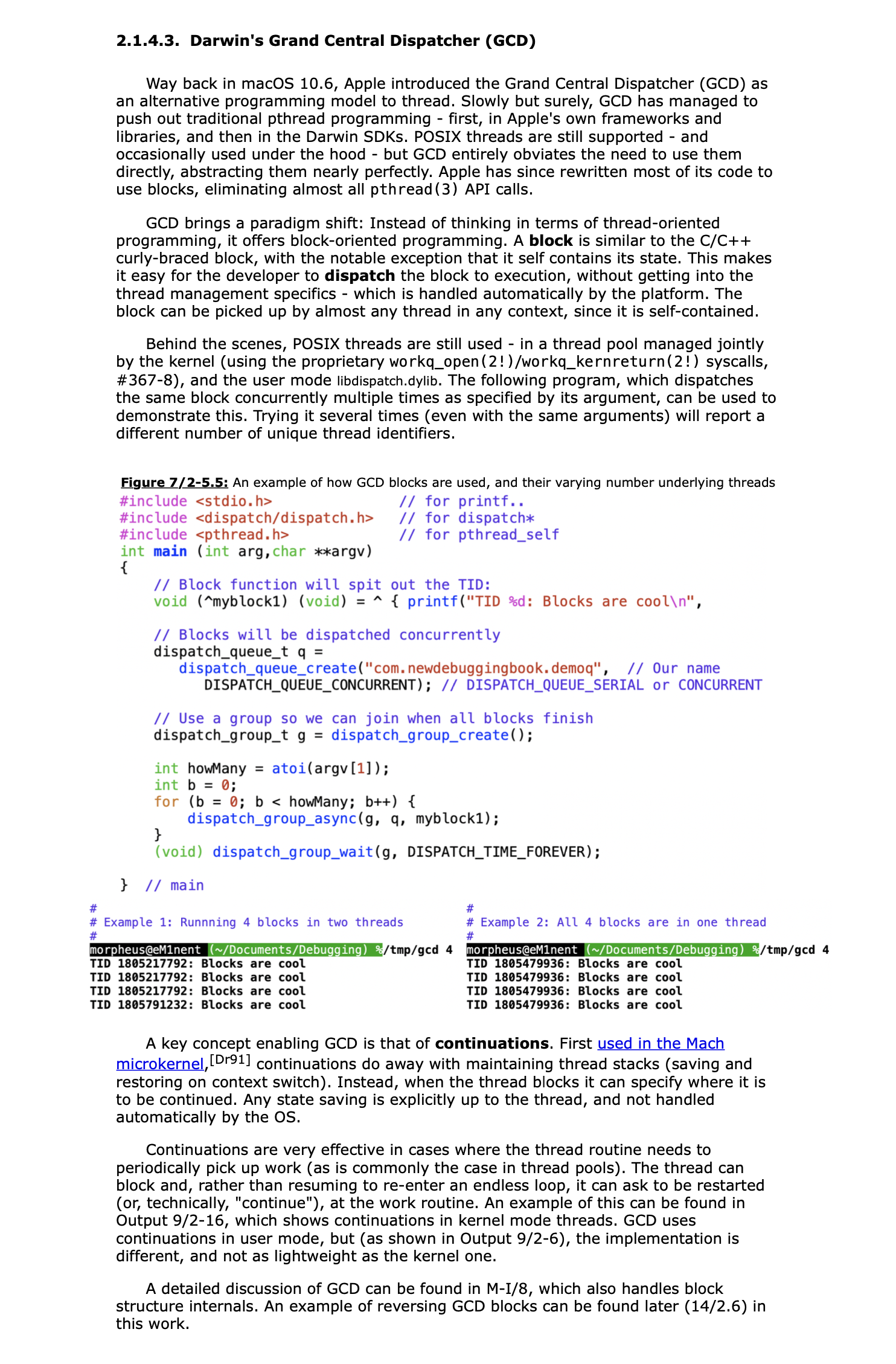
- 2.1.4.3: Added light discussion on GCD, since it overlaps with M-I/8, but
is still important for later (in 14 I demonstrate block reversing).
- 2.2: Added note on ARM's "Future Architecture Technologies" specifying
FEAT_TPS[P] at the end of 7/2.2 (after Figure 7/2-6, before
2.2.1:
Note, that at present nothing prevents one thread from accessing
another's TSD, since all data lives in the same memory space. ARM v9.8's road
map details FEAT_TPS and FEAT_TPSP, "Thread Private
State Checking" for EL0 and EL1/2 (respectively), using two new register sets
of TP[MIN/MAX]n_ELx, defining bounds in memory where TSD
resides.
Chapter 8:
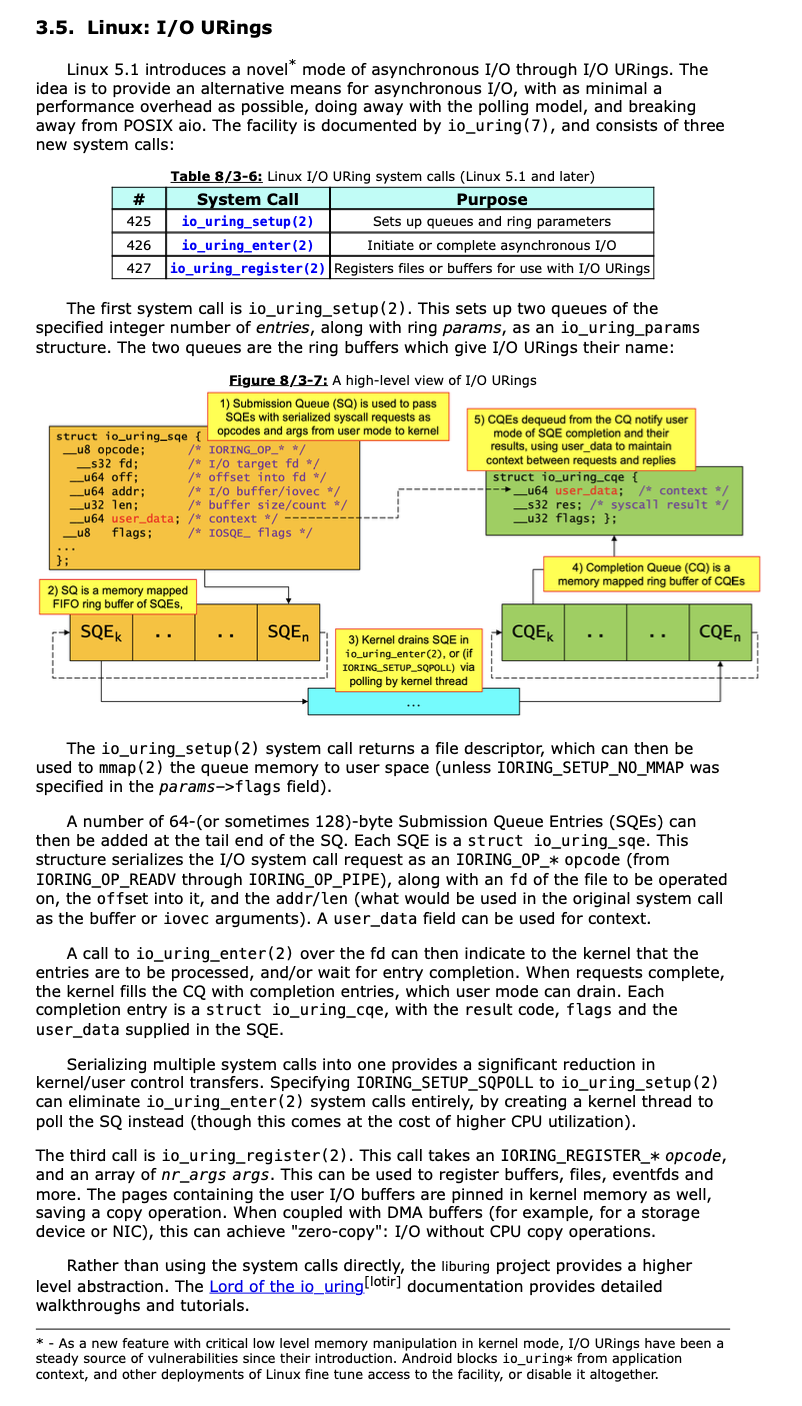
- Added overview of I/O URings (I'm sure people will not like my upper
case, but, ...)
This doesn't change page count since Chapter 8 had a blank page at the end..
Chapter 9:
- 2.2: Added footnote for The proc_info_extended_id(2!) variant (#545) uses 64-bit PIDs, funnels to same code path.
This pushed existing foot note about info leaks (:-)) to **.
Chapter 12:
Chapter 13:
- Split 2.2.2.4.1 to insert 2.2.2.4.2 for "Typed Allocations", since this is
now being referred to from the XZone section in Chapter 6. This bumped up the
old 2.2.2.4.2 through 2.2.2.4.4.